Calculate your Body Mass Index and get personalized recommendations based on WHO standards.
years
cm
kg
Your BMI—kg/m²
Enter your data
Underweight
Normal
Overweight
Obese
1618.5253040
Category—
Healthy weight range—
BMI Prime—
Ponderal Index—
RecommendationEnter your height and weight
What is BMI?
Body Mass Index (BMI) is a measure that helps assess whether your weight is appropriate for your height. Formula: BMI = weight (kg) / (height (m))²
BMI Categories (WHO)
Less than 16 — Severe underweight
16 – 18.5 — Underweight
18.5 – 25 — Normal weight
25 – 30 — Overweight
30 – 35 — Obesity Class I
35 – 40 — Obesity Class II
More than 40 — Obesity Class III
What is BMI Prime?
BMI Prime is the ratio of a person's measured BMI to the upper limit of normal BMI (25 kg/m²). A BMI Prime of less than 0.74 is underweight, 0.74-1 is normal, above 1 is overweight, and above 1.2 is obese.
What is Ponderal Index?
The Ponderal Index (PI) is similar to BMI but uses height cubed instead of squared. It's more reliable for very tall or short individuals, while BMI tends to record uncharacteristically high or low body fat levels for those on the extreme ends of height.
Important to know
BMI is a reference indicator. It doesn't account for muscle mass, age, gender, and other individual factors. For an accurate health assessment, consult a doctor.
Why Use Our Free BMI Calculator?
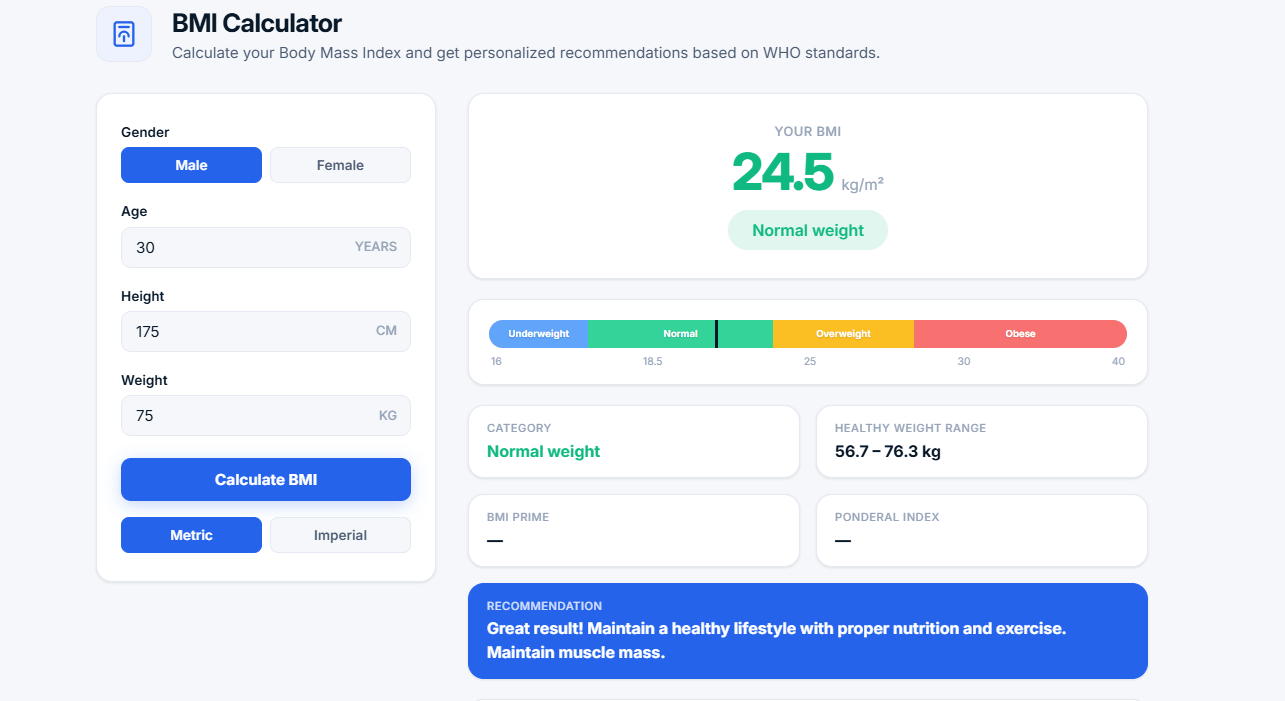
Figure 1: BMI Calculator — calculate your Body Mass Index with personalized health recommendations
Our free BMI calculator helps you quickly determine your Body Mass Index using either metric or imperial units. Whether you're tracking your fitness journey or consulting with a healthcare professional, this tool provides accurate results based on the World Health Organization (WHO) classification system.
💡 Pro Tip: While BMI is a useful indicator, it doesn't account for muscle mass, bone density, or overall body composition. For a complete health assessment, consider measuring your waist circumference, body fat percentage, and consulting with a healthcare provider.
What is Body Mass Index (BMI)?
Body Mass Index is a simple measure that uses your height and weight to estimate body fat. A healthy BMI range is between 18.5 and 24.9. Our calculator provides instant results with color-coded categories for easy understanding.
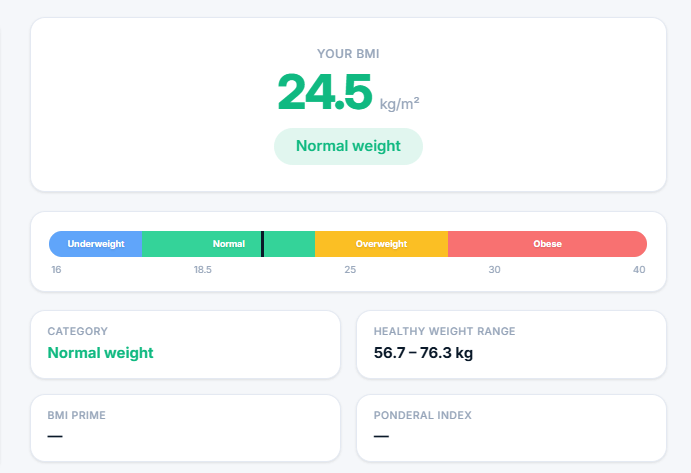
BMI is calculated using the formula: BMI = weight (kg) / (height (m))². For example, a person weighing 75kg with a height of 1.75m would have a BMI of 24.5, which falls within the normal weight range.
BMI Formula
Metric: BMI = weight (kg) / height² (m)
Imperial: BMI = 703 × weight (lbs) / height² (in)
Example: 75 kg / (1.75 m)² = 24.5 kg/m²
What is BMI Prime?
BMI Prime is the ratio of a person's measured BMI to the upper limit of normal BMI (25 kg/m²).
BMI Prime = BMI / 25
Less than 0.74: Underweight
0.74 – 1.0: Normal weight
1.0 – 1.2: Overweight
Greater than 1.2: Obese
What is Ponderal Index?
The Ponderal Index (PI) is similar to BMI but uses height cubed instead of squared. It's more reliable for very tall or short individuals.
PI = weight (kg) / height³ (m)
Imperial: PI = height (in) / ∛weight (lbs)
Who Should Use This Tool?
Fitness enthusiasts tracking their weight loss or muscle gain progress
Healthcare professionals needing quick BMI assessments for patients
Students learning about health metrics and body composition
Anyone curious about their health status
Individuals on a weight management journey monitoring their progress over time
Features of Our BMI Calculator
Completely free to use — no sign-up required
Supports both metric and imperial units (cm/kg or ft/in + lbs)
Instant results with color-coded categories for easy understanding
Personalized recommendations based on WHO standards
Gender-specific advice tailored to men and women
Works on all devices — desktop, tablet, and mobile
Visual BMI scale showing exactly where you fall
Detailed information about healthy weight ranges
BMI Prime and Ponderal Index for advanced analysis
No ads — clean, distraction-free experience
Understanding Your BMI Results
Once you calculate your BMI, you'll see a category that indicates your weight status. Here's what each category means according to the World Health Organization:
BMI Range
Category
Health Risk
BMI Prime
Below 16
Severe Underweight
High
< 0.64
16 – 18.5
Underweight
Moderate
0.64 – 0.74
18.5 – 24.9
Normal Weight
Low
0.74 – 1.0
25 – 29.9
Overweight
Moderate
1.0 – 1.2
30 – 34.9
Obesity Class I
High
1.2 – 1.4
35 – 39.9
Obesity Class II
Very High
1.4 – 1.6
40+
Obesity Class III
Extremely High
> 1.6
BMI for Children and Teens (Age 2-20)
The Centers for Disease Control and Prevention (CDC) recommends BMI categorization for children and teens:
Category
Percentile Range
Underweight
< 5%
Healthy Weight
5% – 85%
At Risk of Overweight
85% – 95%
Overweight
> 95%
BMI Chart for Adults
Figure 2: BMI categories based on height and weight (WHO classification)
Limitations of BMI
While BMI is a useful screening tool, it has several limitations:
Muscle mass: Athletes and bodybuilders may have high BMI due to muscle, not fat
Age: BMI categories may not be appropriate for older adults
Gender: Men and women have different body fat distributions
Ethnicity: Health risks can vary between ethnic groups at the same BMI
Pregnancy: BMI is not accurate during pregnancy
Risks Associated with Being Overweight
According to the Centers for Disease Control and Prevention (CDC), being overweight increases the risk of:
High blood pressure
Higher levels of LDL cholesterol
Type II diabetes
Coronary heart disease
Stroke
Gallbladder disease
Osteoarthritis
Sleep apnea
Certain cancers (endometrial, breast, colon, kidney, gallbladder, liver)
Low quality of life
Risks Associated with Being Underweight
Being underweight also has associated risks:
Malnutrition, vitamin deficiencies, anemia
Osteoporosis
Decrease in immune function
Growth and development issues
Reproductive issues in women
Increased risk of mortality
Frequently Asked Questions
Is BMI accurate for everyone?
No. BMI doesn't account for muscle mass, bone density, age, or gender. It's a screening tool, not a diagnostic one. Athletes may have high BMI due to muscle mass, while older adults may have normal BMI but low muscle mass.
What's a healthy BMI for women?
The healthy BMI range (18.5-24.9) applies to both men and women. However, women typically have higher body fat percentages than men at the same BMI. Our calculator provides gender-specific recommendations.
What's a healthy BMI for men?
Men should aim for a BMI between 18.5 and 24.9. However, men with high muscle mass (athletes) may have a BMI above 25 while still being healthy. Consider additional metrics like waist circumference and body fat percentage.
Does BMI change with age?
Yes. As we age, we tend to lose muscle mass and gain fat, even if our weight stays the same. This means BMI may underestimate body fat in older adults. Consult your doctor for personalized advice.
Is this BMI calculator free?
Yes! Our BMI calculator is completely free to use with no sign-up required. Use it as many times as you want to track your progress.
Does BMI work for children?
BMI for children is calculated differently using age and gender-specific percentiles. Our calculator is designed for adults aged 18 and above. For children, consult your pediatrician.
Why Choose Our BMI Calculator?
100% Free: No sign-up, no limits, no hidden fees
Privacy First: All calculations happen in your browser — no data sent to servers
Accurate Results: Uses WHO classification standards
Visual Feedback: Color-coded categories and BMI scale
Personalized: Gender-specific recommendations
Advanced Metrics: BMI Prime and Ponderal Index included
We use cookies to improve our website. By clicking "Accept", you agree to all types of cookies. "Decline" means only essential cookies will be used. Learn more in our Cookie Policy and Privacy Policy.